
- All
- Product Name
- Product Keyword
- Product Model
- Product Summary
- Product Description
- Multi Field Search
 English

Views: 0 Author: Site Editor Publish Time: 2026-10-20 Origin: Site


The nutraceutical market is currently experiencing a massive paradigm shift. Global consumers increasingly demand vegan, halal, and kosher-certified products. Contract manufacturers must now juggle a wider array of distinct product lines than ever before. This industry-wide pivot means that executing rapid, seamless recipe changeovers is no longer just a routine maintenance task. It has become a critical competitive advantage. Facilities that can pivot quickly without bleeding capital will dominate the space.
Analyzing current manufacturing trends reveals a sharp move toward high-mix, low-volume production. Health brands are frequently launching highly specialized, limited-edition plant-based supplements to capture niche markets. Consequently, production lines can no longer afford to run a single monolithic recipe for weeks on end. Operational agility is the new industry standard. If your facility produces vegan softgels, you already know that plant-based gelatin behaves entirely differently than traditional animal-derived gelatin. Formulations relying on tapioca starch or carrageenan extracts are notoriously temperamental.
Transitioning to a new formulation involves much more than pouring a different liquid into the hopper. It requires a highly systematic process of deep cleaning, precise mechanical adjustments, software recalibration, and strict quality control. In this comprehensive guide, we will walk you through the exact steps, practical field-tested practices, and technical considerations required to seamlessly switch recipes on your encapsulation equipment.
Preparation is Crucial: A successful recipe switch begins with rigorous cleaning protocols. Utilizing Clean-in-Place systems prevents dangerous cross-contamination between different active pharmaceutical ingredients or gel masses.
Temperature and Viscosity Matter: Plant-based gels exhibit a notoriously narrow thermodynamic window. They demand different, often significantly higher, temperature settings and precise viscosity controls compared to traditional gelatin.
Tooling Changes are Required: Switching capsule sizes or shapes necessitates physically swapping out die rolls, injection wedges, and distribution plates to ensure accurate encapsulation.
Automation Speeds Up the Process: Modern manufacturing equipment allows operators to save and instantly load specific recipe parameters directly from a digital touchscreen.
Post-Switch Testing is Non-Negotiable: Always execute a slow-speed test batch to verify seal thickness, fill weight accuracy, and visual integrity before initiating full-scale commercial production.
Before initiating a complex changeover procedure, operators must understand the mechanical and thermal principles driving a Vege Capsule Production Machine. Unlike traditional two-piece hard capsule fillers that mechanically join pre-fabricated dry shells, softgel encapsulation equipment forms the capsule shell and injects the fill material simultaneously. This occurs in a continuous, synchronized rotary die process.
The system utilizes a plant-based polymer matrix. Picture the thick, slightly tacky consistency of heated tapioca starch and seaweed extracts being pumped from a humming melting tank into spreader boxes. This material is then cast onto chilled cooling drums to form two continuous, thin ribbons. The filler mechanism then injects a precise micro-dosage of the active ingredient between these two ribbons. This payload might be a slick lipid-based oil, a gritty suspension, or a dense botanical paste.
Simultaneously, the rotating die rolls cut the ribbons into the desired shape. They apply intense thermal pressure to hermetically seal the capsule. Plant-based polymers possess higher molecular weights and distinct gelling behaviors compared to bovine or porcine gelatin. Therefore, the machine heating manifolds and sealing mechanisms must operate under highly specific, unforgiving tolerances. Advanced machines utilize independent servo drives, allowing precise die roll speeds up to 5 or 7 revolutions per minute specifically optimized for complex vege formulations.
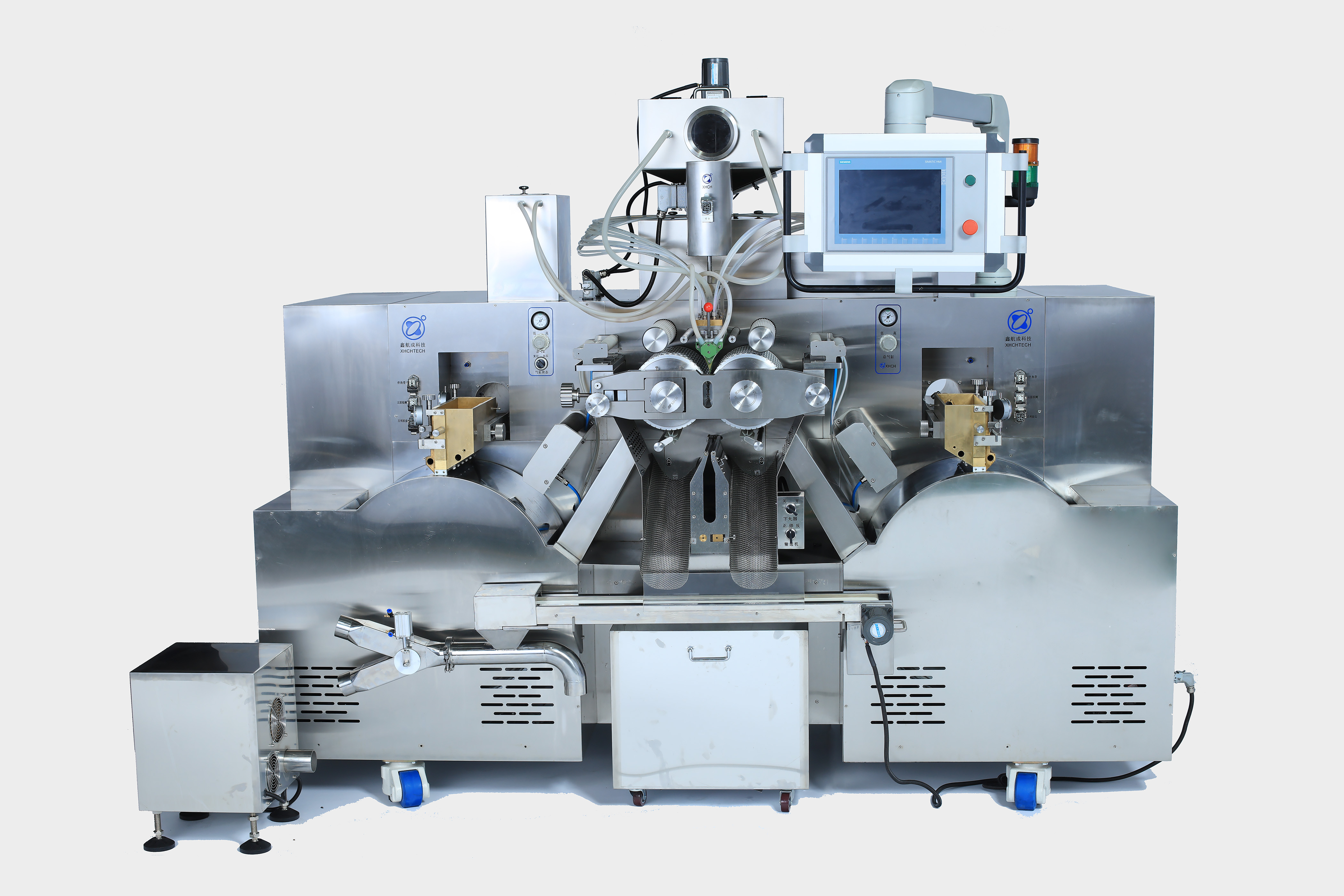
Executing a recipe changeover is a delicate, highly technical operation that directly impacts your Overall Equipment Effectiveness. Facility operators are typically altering the shell formulation, the fill material, or both. Transitioning from a transparent vegan gel to a pigmented one requires purging the entire line. Changing the internal payload from a low-viscosity vitamin E oil to a thick herbal suspension requires complete pump recalibration.
Plant-based gelatin substitutes are highly sensitive to thermal fluctuations. They exhibit a sharp setting curve. If the temperature drops even slightly below the required threshold, the gel mass solidifies rapidly into a stubborn, rubbery mess. If the previous recipe is not systematically purged from the fluid paths, or if the new thermal profile is incorrectly calibrated on your softgel machine, manufacturers face severe operational risks. These risks include clogged spreader box manifolds, misaligned injection wedges, and deformed capsules with compromised seams. Absolute precision during this switch minimizes the waste of high-value raw materials and protects the mechanical longevity of your line.
Introducing a new formulation into a contaminated fluid path is a direct violation of Good Manufacturing Practices. Consequently, the initial phase of switching a recipe involves a rigorous teardown, purging, and cleaning protocol. Factory floor veterans know you simply cannot cut corners here.
First, safely evacuate any residual plant-based gel from the primary holding tanks, heated transfer hoses, and spreader boxes. Gravity draining combined with low-pressure air purging effectively clears sticky residue from the lines. Next, empty the medicine hopper completely. Actuate the material pump to cycle the pistons until the internal fluid lines, distribution plates, and injection wedge are entirely devoid of the previous active ingredient.
Carefully dismantle the injection wedge, die rolls, and the components of the medicine pump. These precision-machined parts must be scrubbed using validated food-grade solvents or high-temperature purified water. The specific cleaning agent depends strictly on whether the previous fill material was oil-based or water-soluble.
Furthermore, if your equipment features an integrated Clean-in-Place system, initiate the automated cleaning cycle. This flushes the internal piping with designated detergents and sanitizers. Following the wash cycle, ensure all internal surfaces are bone dry. Even a microscopic amount of residual moisture will react with the new vege gel mass. This moisture causes catastrophic ribbon structural failures during the casting phase.
Once the equipment has been verified spotlessly clean and dry, operators can proceed with the mechanical and software setup for the new formulation. Below is a structured, field-tested breakdown of the changeover process.
If the new production batch requires a different physical specification, the corresponding die rolls must be installed. For instance, transitioning from a Size 10 Oval to a Size 20 Oblong requires a complete tooling swap. Operators must align the mechanical timing marks on the gears with absolute precision. This ensures the left and right gel ribbons synchronize perfectly. Subsequently, seat and calibrate the matching injection wedge designed specifically for that die cavity.
Attach the staging tank containing the newly formulated plant-based gel mass to the machine feeding system. Concurrently, load the medicine hopper with the new active fill material. Systematically double-check all sanitary fittings, valves, and heated transfer hoses. They must be tightly clamped down to maintain pressure and prevent messy material leaks on the factory floor.
Industrial encapsulation systems utilize advanced touchscreen controllers as the brain of the operation. Navigate to the recipe management interface. If the formulation is an existing, pre-validated recipe, simply select it from the database. The system automatically calibrates the servo motors to adjust injection timing and pump stroke volume. If initiating a novel recipe, operators must manually input the validated engineering parameters. These include target fill weight, rotational die roll speed, and multi-zone temperatures.
Initiate the flow of the gel mass through the spreader boxes to cast the new vege ribbons onto the chilled cooling drums. Thread the solidified ribbons over the lubrication rollers and carefully feed them through the nip of the die rolls. Finally, prime the medicine pump. This ensures the new active ingredient flows consistently to the precise tip of the injection wedge, pushing out any trapped air pockets in the fluid path.
Beyond the external hardware, the core mechanical challenge of a recipe switch resides within the automatic softgel filler mechanism. Specifically, the positive displacement medicine pump requires careful attention. Different active ingredients possess vastly different rheological properties. Transitioning from a thin hemp seed oil to a dense herbal paste necessitates specific mechanical recalibrations.
The operator physically adjusts the pump piston stroke length using micrometer dials. This mechanical adjustment dictates the exact volumetric displacement of the fluid. It ensures the dispensed dosage meets the strict milligram requirements of the batch record. In addition, the filler mechanism must inject the liquid payload at the exact microsecond the rotating die rolls form the bottom half of the capsule cavity. If this timing is advanced or delayed even slightly, hydraulic pressure will cause the capsule to burst.
When processing highly viscous fill materials, operators must activate the medicine hopper thermal heating jacket. Elevating the temperature reduces fluid resistance. This ensures a consistent, laminar flow into the pump cylinders and prevents destructive pump cavitation.
Standard bovine or porcine gelatin melts and forms seals at relatively low, forgiving temperatures. In contrast, plant-based polymers behave entirely differently. They demand a much more aggressive thermal profile. When executing a recipe changeover on your soft capsule filling machine, thermal calibration is the most critical variable to control.
The spreader box temperature must be set significantly higher than traditional gelatin parameters. Temperatures typically range between 60 degrees and 90 degrees Celsius, depending strictly on the specific ratio of starch to carrageenan in your formulation. This intense heat keeps the polymer matrix fluid enough to cast cleanly. Operators must also physically adjust the spreader blade gap using feeler gauges. This achieves the precise ribbon thickness required to support the new capsule size and weight.
The injection wedge serves a critical dual purpose. It delivers the fill material and applies localized thermal energy to heat the inner surfaces of the two gel ribbons. This allows them to fuse under the pressure of the die rolls. Vegan capsules generally require a much hotter wedge temperature to achieve the cross-linking of the polymer chains. Operators must monitor this parameter obsessively. Excessive heat will melt and tear the ribbons, causing a catastrophic web failure. Insufficient heat will fail to fuse the polymers, resulting in unsealed capsules that leak active ingredients all over the conveyor belt.
Never switch a recipe, hit start, and immediately walk away assuming the equipment is ready for full-scale manufacturing. Transitioning from one plant-based formulation to another introduces countless variables. You must validate the changeover with a controlled, highly scrutinized test run.
Begin by engaging the equipment at a significantly reduced operational speed, typically between 1 to 2 revolutions per minute. This slow pace allows the machine to stabilize its thermal zones. It lets operators closely observe ribbon formation and injection timing in real-time. Once a small, manageable batch of sample capsules is produced, execute a series of rigorous quality control checks.
Fill Weight Accuracy: Utilize a calibrated analytical balance to weigh a sample set of capsules. This verifies that the medicine pump is dispensing the exact volumetric dosage without statistical deviation.
Seam Integrity and Burst Strength: Vegan capsules can be highly prone to seam failure if the wedge temperature is slightly off. Perform physical stress tests by squeezing the sample capsules. If the seams rupture or leak under minimal pressure, incrementally increase the wedge temperature or tighten the mechanical pressure applied by the die rolls.
Shell Thickness Uniformity: Bisect a finished capsule using a scalpel and measure the cross-sectional shell thickness using digital calipers. The thickness of the top, bottom, and seams must remain uniform. Asymmetrical thickness indicates an improperly calibrated spreader box blade gap.
Visual Defect Inspection: Examine the capsules under bright lighting for aesthetic defects. Look for trapped air bubbles, tailing where fill material leaks into the seam, or discoloration caused by thermal degradation.
Observed Defect | Potential Cause | Recommended Adjustment |
|---|---|---|
Capsules leaking at the seam | Wedge temperature too low; Die roll pressure insufficient. | Increase wedge heating slightly; Tighten die roll pressure mechanism. |
Ribbon tearing during encapsulation | Cooling drum too cold; Gel mass viscosity too high. | Raise cooling drum temperature; Check gel mass holding tank heating. |
Inconsistent fill weights | Air bubbles in the material line; Pump timing misaligned. | Re-prime the medicine pump; Adjust injection timing settings. |
Uneven capsule shell thickness | Spreader box blade gap is asymmetrical. | Recalibrate the left and right spreader box gaps using a feeler gauge. |
Only after the test batch meets all predefined Quality Control specifications should the operator gradually ramp the equipment up to its optimal commercial production speed.
If your manufacturing facility frequently switches recipes to accommodate small-batch runs or diverse client product lines, the underlying engineering of your equipment dictates overall profitability. The mechanical architecture and software capabilities directly determine how much downtime is bled away during a changeover.
Older, mechanically driven machines rely heavily on complex drive shafts, chains, and physical cams. On these legacy systems, operators manually adjust gears and timing mechanisms using wrenches. This process is highly susceptible to human error and easily drags a single recipe switch out for an entire eight-hour shift. Upgrading to modern equipment transforms this grueling task into a streamlined, predictable process.
When evaluating machinery designed for operational agility, production managers should prioritize specific technical capabilities.
Independent Servo Motors: Unlike traditional drives linking all moving parts to a single main motor, modern systems utilize separate servo motors for the die rolls, the medicine pump, and the cooling drums. This allows operators to make instantaneous micro-adjustments to alignment and timing via software. It completely eliminates the need to physically stop the machine to turn mechanical gears.
High-Capacity Thermal Control: Plant-based materials require robust heating. Look for machines featuring PID temperature control systems capable of maintaining spreader box and wedge temperatures up to 95 degrees Celsius without fluctuating.
Recipe Memory Systems: Advanced touchscreen interfaces store hundreds of validated recipes. Once an operator calibrates the perfect parameters for a specific plant-based formulation, they save the profile. Selecting it in the future automatically adjusts pump timing, injection volumes, and thermal zones with a single digital command.
Tool-less Changeovers: Engineering designs utilizing pneumatic clamping or quick-release mechanisms allow operators to swap heavy die rolls and injection wedges safely and rapidly without picking up a wrench.
Switching a recipe on a vege capsule production line is a multifaceted process demanding impeccable cleanliness, mechanical precision, and a deep understanding of plant-based material behaviors. By adhering to a strict, standardized protocol, you ensure a smooth transition with minimal downtime. Meticulously purge the old materials, safely swap the tooling, carefully program the digital controller, and calibrate the thermal zones for the specific vege gel. As vegan supplements continue their rapid ascent in the global market, mastering the operation and changeover of your encapsulation equipment keeps your production line agile, efficient, and highly profitable. Ready to upgrade your production line and eliminate changeover bottlenecks? Explore the high-performance, servo-driven encapsulation solutions at Sinagel to find the exact equipment tailored to your manufacturing needs.
The duration of a recipe switch depends heavily on the machine underlying technology and whether a comprehensive deep clean is required between batches. For standard mechanical machines, a full changeover can take anywhere from 4 to 6 hours. This includes draining the gel mass, dismantling the pump, cleaning all contact parts, installing new tooling, and recalibrating temperatures. However, operating an advanced servo-driven machine equipped with automated Clean-in-Place systems and digital recipe memory reduces the changeover time to just 1 to 2 hours.
You can reuse the same die rolls only if the new recipe requires the exact same capsule size and geometric shape, such as a Size 10 Oval. If the new formulation uses the same shell dimensions but simply changes the active ingredient inside, the die rolls can remain in place. However, if the new recipe calls for a different dosage volume necessitating a larger or smaller cavity, or a different shape entirely, you must physically remove the existing die rolls and install the appropriate new set. Whenever die rolls are changed, the corresponding injection wedge must also be swapped to match the new cavity alignment.
Leaking capsules immediately following a recipe changeover are almost always symptomatic of thermal or mechanical misalignment. Plant-based gels require highly specific heat settings to fuse properly. If the injection wedge temperature is too low, the two gel ribbons will not melt enough to form a hermetic seal. Conversely, if the die roll pressure is insufficient, the ribbons will not be pressed together tightly enough during the cutting phase. Another common culprit is improper injection timing. If the liquid is injected a fraction of a second too early or too late, it contaminates the seam area before it seals, resulting in immediate leakage.
Standard equipment designed strictly for animal-based gelatin often struggles to process vegan formulations without significant modifications. Plant-based gel mass possesses an inherently higher viscosity and requires considerably higher processing temperatures to remain fluid. A standard machine may lack the necessary thermal output in its spreader boxes and holding tanks. To run vege gel effectively, standard equipment usually needs retrofitting with specialized high-temperature heated tanks, stronger material pumps capable of handling thicker fluids, and modified spreader boxes.
Saving a new recipe is a straightforward process on modern, logic-controlled equipment. Once operators manually dial in the perfect operational settings during the test batch phase, they navigate to the Recipe Management tab on the main touchscreen interface. These settings include the precise wedge temperature, cooling drum speed, pump stroke length, and die roll pressure. From there, the operator creates a new profile, assigns it a specific product code, and saves it. During future production runs, selecting this saved profile prompts the machine to automatically adjust its servo motors and thermal controllers to match those exact specifications.
Preventing cross-contamination requires a complete systemic purge and validated chemical cleaning. You cannot simply flush the lines with water. Operators must completely dismantle the fluid path, including the spreader boxes, material pumps, and injection wedges. These components must undergo a high-temperature wash utilizing food-grade alkaline detergents to break down animal proteins, followed by a purified water rinse. Swab testing is highly recommended to verify the absolute absence of animal DNA before introducing the vegan polymer matrix into the system.
Unlike animal gelatin which requires heavily dehumidified rooms, plant-based gels are slightly more resilient to ambient moisture but highly sensitive to ambient temperature drops. The encapsulation room should ideally be maintained between 20 and 24 degrees Celsius, with a relative humidity controlled between 35 and 45 percent. If the ambient room temperature drops too low, the vege ribbons will cool too rapidly after leaving the casting drums, losing their elasticity and tearing before they reach the die rolls.


