
- All
- Product Name
- Product Keyword
- Product Model
- Product Summary
- Product Description
- Multi Field Search
 English

Views: 0 Author: Site Editor Publish Time: 2026-10-23 Origin: Site


Players despise when barrel jams ruin their match. A ruined game often traces back to poor manufacturing tolerances. In the highly competitive paintball industry, spherical perfection dictates product performance on the field. Flawlessly round paintballs ensure aerodynamic stability and consistent velocity. They also prevent catastrophic marker malfunctions. Even microscopic deviations cause unpredictable flight curves or chamber ruptures. This damages a manufacturer's brand reputation instantly.
Understanding this precise geometry starts on the factory floor. Paintballs are essentially specialized thick-shelled gelatin capsules. Manufacturers rely on a dedicated Paintball Production Machine utilizing advanced rotary die technology. Operators must monitor the entire cycle from ribbon formation to final curing. We will break down how engineers verify and maintain spherical tolerances using real-time calibration, optical inspections, and controlled drying systems.
Paintballs travel at velocities hitting 300 feet per second. At these extreme speeds, flight physics demand absolute symmetry. Uniform air resistance keeps the trajectory straight. Conversely, a one-millimeter variance creates an egg shape. Uneven air pressure induces an erratic Magnus effect. The projectile will hook or dive unpredictably. For tournament players, an out-of-round paintball is entirely useless.
Furthermore, modern markers operate with exceptionally tight tolerances. Barrel bore sizes match the caliber precisely for maximum air efficiency. Misshapen paintballs generate severe friction and an improper air seal. If the axis is too wide, the shell fractures inside the chamber. This barrel break leaves sticky gelatin and paint residue behind. Subsequent shots will curve wildly until the player swabs the equipment clean.
Industry standards dictate a strict roundness tolerance of plus or minus 0.005 inches across all axes. Achieving this microscopic precision requires sophisticated tooling and rigorous quality control protocols throughout the production cycle.
Creating a liquid-filled sphere relies heavily on pharmaceutical technology. Paintballs function as large heavy-duty softgel capsules. Standard medical capsules are usually oblong for easy swallowing. Paintball tooling, however, is engineered exclusively to produce flawless spheres.
Two continuous gelatin ribbons drive the encapsulation process. They pass through lubricating rollers and converge between counter-rotating die rolls. These rolls feature matching hemispherical cavities machined with extreme precision. The dies press together, forcing the gelatin ribbons into the cavities to form the shell halves.
Specifically, the actual shaping occurs at the injection wedge. This heated brass component sits right above the die convergence point. At the exact millisecond the dies form a seal, the pump injects a precise volume of liquid paint. Hydraulic pressure forces the flexible gelatin outward. The capsule expands into a perfect round shape before the tooling cuts and seals it completely.
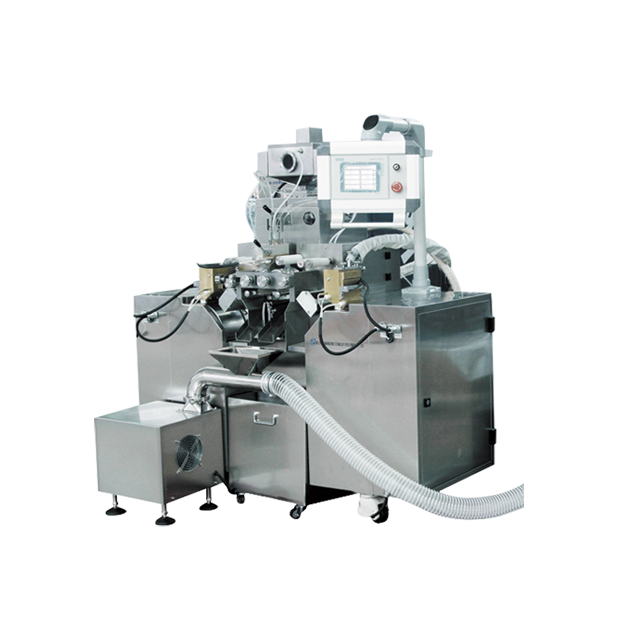
Operators cannot wait for a finished batch to spot defects. Real-time assessment keeps the machinery calibrated and minimizes material waste.
Manual micrometer sampling remains the foundational method on the shop floor. Operators pull random batches from the exit chute every twenty minutes. Using calibrated digital micrometers, they measure seam-to-seam, pole-to-pole, and diagonal axes. Variances beyond the acceptable threshold require immediate machine adjustments.
Gelatin ribbon thickness directly impacts final geometry. A thicker left ribbon creates asymmetrical mass distribution. The capsule will cool into an oval shape. Engineers monitor this using laser gauges before the web reaches the tooling. Spreader boxes must cast identical thicknesses—typically ranging from 0.030 to 0.040 inches.
Manual sampling leaves room for human error. To bridge this gap, modern facilities upgrade to an Intelligent Softgel Encapsulator. These systems feature automated optical inspection. High-speed cameras scan capsules dropping from the tooling. The software analyzes 360-degree geometry in milliseconds. The PLC interface alerts operators to deviations instantly, automatically rejecting out-of-spec capsules.
Mechanical synchronization is non-negotiable. Minor gear discrepancies manifest as severe physical defects in the finished product.
Rotary dies require microscopic alignment. Left and right hemispherical cavities must match perfectly. Misalignment creates an offset seam, known on the shop floor as a lip. This lip destroys aerodynamic stability and creates a weak point prone to rupturing in the barrel. Engineers use specialized alignment tools to ensure seams remain completely flush.
In addition, medicine pump timing must synchronize with die rotation. The injection pump operates on a strict mechanical cycle. Injecting liquid too early stretches the gelatin seal, causing oblong shapes. Late injection results in under-filled dimpled capsules lacking internal hydraulic pressure. Calibrating the pump gear to the exact moment of cavity closure forces the gelatin into a true sphere.
Forming the sphere is only the first step. The post-production environment dictates final product quality.
Freshly extruded paintballs are warm and highly pliable. They resemble small liquid-filled water balloons. Sitting stationary on a conveyor allows gravity to pull the heavy fill downward. The bottom sags and flattens. Once the gelatin cures with a flat spot, the product is permanently ruined.
To counter this, operators direct the output into in-line tumble dryers. Rotating cylindrical baskets keep the product moving continuously. This dynamic tumbling prevents gravity from distorting the shape. High-volume blowers extract moisture evenly, cementing the spherical geometry.
The paintball industry is currently experiencing a massive shift toward fully biodegradable, PEG-based fill formulations. While environmentally friendly, these sustainable materials exhibit vastly different thermal retention and viscosity properties compared to traditional oil-based paints. This transition complicates roundness maintenance. Alternative fills cure at unpredictable rates, increasing the risk of dimpling or ovaling. Forward-thinking manufacturers now rely on data-driven drying. By integrating smart humidity sensors and AI-assisted HVAC controls, engineers dynamically adjust tumble drying times to counteract unpredictable curing behaviors.
Final quality control relies on automated sorting to catch minor variations. Calibrated roller sorters use diverging spinning cylinders. Perfectly round capsules fall through designated gaps into premium collection bins. Oversized or oval shapes travel further down the line for rejection.
Tournament-grade production supplements physical rollers with optical sorting machines. High-speed conveyors pass capsules under multiple cameras. Image recognition software identifies microscopic flat spots or irregular shapes. A precise blast of compressed air ejects defective units instantly, ensuring strict roundness guarantees.
Equipment Type | Production Scale | Drive Technology | Roundness Control Features |
|---|---|---|---|
Lab Scale Encapsulator | R&D / Small Batch | Standard Mechanical | Manual ribbon adjustment, ideal for validating fill viscosity and shell elasticity. |
Intelligent Encapsulator | Medium to High | Servo Motor Driven | Automated optical inspection, PLC touch screen, auto gelatin thickness adjustment. |
High-Speed Encapsulator | Mass Manufacturing | Advanced Direct Drive | Zero gear backlash, automated cooling drums, maintains perfect die timing at high RPMs. |
Transitioning a new formula to mass manufacturing requires careful equipment selection and parameter tuning.
Before scaling up, engineers validate formulas on a Lab Softgel Machine. This compact setup tests shell thickness and fill viscosity in controlled batches. R&D confirms the formula has the correct elasticity to hold a spherical shape under pressure without wasting hundreds of gallons of material.
Once validated, facilities upgrade to a High Speed Softgel Machine for mass output. High-volume runs introduce thermal fluctuations. Premium high-speed models utilize advanced servo motors instead of mechanical linkages. This eliminates gear backlash and maintains perfect die timing at speeds exceeding 100,000 capsules per hour. Automated cooling drums stabilize ribbon temperatures, preventing the heat buildup that causes shape deformation during continuous shifts.
Even top-tier facilities encounter defects. Quick troubleshooting minimizes downtime and material waste on the shop floor.
Dimpling indicates under-filling or excessively rapid drying. The capsule lacks internal pressure. Engineers must calibrate the injection pump for higher fill volume or lower the HVAC drying speed.
Egg-shaping stems from uneven ribbon thickness or incorrect wedge temperatures. The fix involves using a micrometer to verify ribbon thickness, recalibrating the spreader box gaps, and checking the brass wedge heating elements.
Offset seams point directly to die roll misalignment. Operators must halt the line, realign the die timing marks, and check gear synchronization.
Flat spots occur when warm capsules sit stationary. Ensure a smooth transfer from the exit chute to the tumble dryers. Verify the baskets rotate at the correct RPM to keep the product tumbling.
High-quality paintballs typically have a roundness tolerance of plus or minus 0.005 inches. Anything beyond this microscopic variance negatively impacts how the paintball fits into the marker barrel. This leads to poor air efficiency, erratic flight trajectories, and a high risk of barrel breaks during gameplay.
Yes, but it requires highly specific modifications. The machine must feature specialized tooling with perfectly spherical die cavities rather than standard oval shapes. Furthermore, paintball production requires a much more robust tumble drying setup to handle heavier capsules and prevent flattening.
Critical parameters like die alignment, injection pump timing, and ribbon thickness require calibration at the start of every production shift. Machine operators should also pull random quality control samples every twenty minutes during an active run to maintain strict tolerances.
Dimples usually occur during the post-encapsulation drying process. This happens if the curing room humidity is incorrect or if the initial paint fill volume was too low. The capsule lacks enough internal hydraulic pressure to remain perfectly spherical as the gelatin shell hardens.
Gelatin is highly temperature-sensitive. Excessive heat causes the ribbons to soften too much, leading to elongated oval shapes as they pull through the dies. Conversely, temperatures that are too low prevent proper seam sealing, causing the capsules to split open under pressure.
Engineers use precision laser gauges or highly calibrated dial indicators mounted directly above the cooling drums. This allows for real-time monitoring. If the thickness deviates from the 0.030 to 0.040-inch standard, operators can adjust the spreader boxes immediately.
Maintaining strict spherical tolerances demands precision equipment and reliable production data. Upgrading your encapsulation line eliminates barrel breaks and elevates your brand reputation on the field. Whether you need a compact R&D setup or a fully automated high-speed production line, selecting the right machinery is critical. Explore the full range of advanced encapsulation solutions at Sinagel to optimize your manufacturing process today.


