
- All
- Product Name
- Product Keyword
- Product Model
- Product Summary
- Product Description
- Multi Field Search
 English


PLG-III type
The Medicine Preparation Tank PLG-III functions as a jacketed mixing and temperature control vessel designed specifically for gelatin mass preparation and fill material compounding in soft capsule production lines. The vessel provides controlled heating, vacuum degassing, and uniform mixing to produce bubble-free gelatin solution with consistent viscosity, directly feeding material to the encapsulation machine. This model has been integrated as standard equipment on 200+ Sinagel softgel production lines installed globally since 2015.
Standard configuration includes a top-mounted agitator drive, sight glass with light, temperature sensor, pressure gauge, all necessary process connections, and a bottom discharge valve. Optional features include load cells for batch weight measurement, CIP spray balls for clean-in-place operation, additional side entry ports for ingredient addition, and explosion-proof electrical components for hazardous area installation.
The Medicine Preparation Tank PLG-III uses a closed three-layer structure: an inner product contact layer, a middle jacket for heating/cooling media circulation, and an outer insulation layer with polished stainless steel cladding. The jacket design provides uniform heat transfer across the inner vessel surface, eliminating cold spots that can cause gelatin viscosity variation. The vessel is rated for full vacuum operation to -0.09 MPa during degassing cycles.
All product contact surfaces are constructed from 316L stainless steel. Non-contact structural components including the jacket and outer cladding are constructed from 304 stainless steel. All internal welds are ground and polished flush with the vessel wall to eliminate product entrapment points.
The mixing assembly is driven by a top-mounted cycloidal pin wheel planetary reducer, providing torque output suitable for high-viscosity gelatin masses. The agitator uses a combined paddle and wall-scraping blade design, with PTFE scrapers maintaining contact with the vessel wall during operation to prevent material burn-on during heating cycles. Agitator shaft and blades are designed for tool-free disassembly to facilitate cleaning between batches.
Parameter | Specification |
|---|---|
Standard nominal volumes | 100 L, 200 L, 300 L, 500 L, 1000 L |
Inner vessel material | 316L stainless steel |
Jacket and outer material | 304 stainless steel |
Inner surface polish | Ra ≤ 0.4 μm, electropolished |
Outer surface polish | Ra ≤ 0.8 μm |
Design working pressure (jacket) | 0.3 MPa |
Design working vacuum (vessel) | -0.09 MPa |
Operating temperature range | 5 °C - 95 °C |
Temperature control accuracy | ±2 °C |
Agitator speed range | 36-72 rpm, variable frequency adjustment |
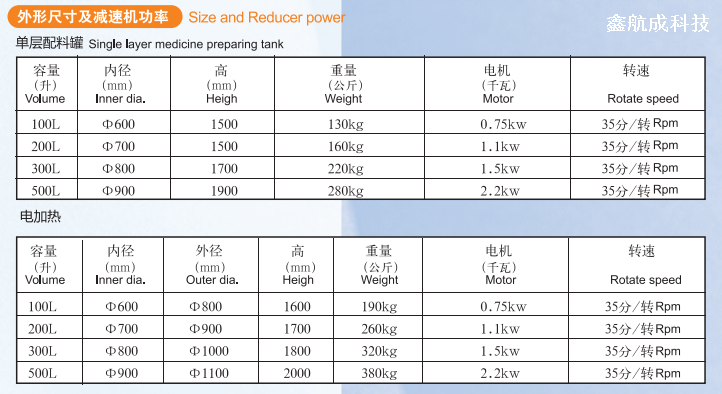
Motor power | 1.5 kW (100-300 L), 2.2 kW (500 L), 4 kW (1000 L) |
Standard connections | Material inlet, vacuum port, compressed air port, hot water in/out, cold water in/out, CIP port, discharge valve |
Certifications | ISO 9001:2015, CE, Pressure vessel inspection report |
Temperature is controlled via hot and cold water circulation through the vessel jacket, with a PT100 temperature sensor mounted in the lower vessel sidewall providing continuous feedback to the control system. Heating rate from 20 °C to 80 °C is 1.5-2 °C per minute with 85 °C inlet water temperature. Cooling rate from 80 °C to 50 °C is 1-1.5 °C per minute with 15 °C inlet water temperature.
The vessel is designed for vacuum operation to remove entrained air from gelatin mass during preparation, eliminating bubble defects in finished softgels. A sterile air breather filter with 0.22 μm PTFE membrane is mounted on the vessel top to prevent contamination during vacuum release. Standard operating vacuum level is -0.06 to -0.08 MPa, with hold times of 15-30 minutes depending on batch size and gelatin viscosity.
All internal surfaces are designed for clean-in-place compatibility when the optional CIP spray ball is installed. Spray ball coverage extends to all internal surfaces including the vessel dome, agitator blades, and bottom dish, with no shadow areas when operated at 1.5-2.0 bar supply pressure. No internal disassembly is required between product changeovers when CIP is utilized.
The Medicine Preparation Tank PLG-III is designed in accordance with GMP pharmaceutical equipment hygiene requirements. All product contact surfaces are free of recesses and dead legs, with all piping connections using sanitary tri-clamp fittings. Sloped bottom design ensures complete product drainage with less than 0.5 L residual volume after discharge. The vessel includes a 100 mm diameter sight glass with LED floodlight for visual inspection of batch conditions during processing.
Each Medicine Preparation Tank PLG-III is pressure tested at 1.5 times design pressure before shipment, with a pressure vessel inspection report provided for all units. Safety features include a pressure relief valve set at 0.32 MPa on the jacket, a vacuum breaker valve to prevent vessel collapse during cooling, and a pressure gauge with visible scale marking safe operating ranges. All electrical components carry CE marking and meet IP65 ingress protection ratings for washdown environments.
Standard production models are available in 100 L, 200 L, 300 L, 500 L, and 1000 L working volumes. Custom volumes between 50 L and 2000 L can be manufactured to purchaser specifications, with engineering drawings provided for approval before production.
The Medicine Preparation Tank PLG-III requires 380V/50Hz three-phase electrical supply (other voltages available on request), hot water supply at 85-90 °C for heating, chilled water supply at 10-15 °C for cooling, compressed air at 0.4-0.6 MPa for pneumatic valves and vacuum release, and a vacuum source capable of -0.08 MPa. Utility connection drawings are provided with each unit.
Factory acceptance testing is performed before shipment, with video documentation available for purchaser review. On-site installation supervision and commissioning can be provided by factory technicians, with typical commissioning time of 1-2 working days including operator training. Installation manuals with exploded parts diagrams are included in the documentation package.
Standard documentation includes material certificates for all product contact stainless steel, pressure test reports, electrical component certificates, weld inspection reports, and surface roughness measurement records. IQ/OQ documentation templates are available upon request to support pharmaceutical validation requirements for commercial manufacturing operations.


