
- All
- Product Name
- Product Keyword
- Product Model
- Product Summary
- Product Description
- Multi Field Search
 English

Views: 113 Author: Site Editor Publish Time: 2026-10-19 Origin: Site


Investing in softgel encapsulation demands a significant technical commitment from your organization. Equipment reliability directly dictates your yield rates, product stability, and long-term production success. Facility operators intimately understand the risks of sudden mechanical downtime. Every halted batch impacts your production schedule.
Market demands shift rapidly today. Consumers actively seek advanced nutraceuticals, complex liquid formulations, and plant-based vegan alternatives. Legacy machinery often struggles to adapt to these strict modern requirements. Engineers originally designed older systems for simpler formulations. Today, old systems simply cannot handle high-viscosity materials efficiently. You must upgrade your infrastructure carefully to maintain high production standards.
We designed this comprehensive manufacturing guide to help you navigate these critical choices. It provides operations and procurement teams an objective framework. You will discover exactly how to evaluate, size, and shortlist the right system. We want you to confidently select machinery matching your exact facility needs.
System Architecture: A complete line requires synchronized integration between gelatin melting, material preparation, encapsulation, and drying systems.
Tooling & Formulations: Modern equipment must balance traditional animal-based gelatin processing with the stricter thermal and viscosity controls required for plant-based (vegan) excipients.
Compliance Integration: Validated pharmaceutical machinery must seamlessly support cGMP standards, with rigorous Factory Acceptance Testing (FAT) prior to deployment.
Building an effective softgel factory equipment line requires immense precision. Every individual component must communicate seamlessly with the next. You cannot treat these machines as isolated islands. We map out the core stages of this architecture below.
The journey begins inside robust stainless steel reactors. Operators use jacketed heating systems to melt the shell material uniformly. You must strictly control the water bath temperatures surrounding the reactor. Vacuum deaeration plays a critical role during this stage. The system pulls a strong vacuum to extract trapped micro-bubbles from the gelatin mass. If micro-bubbles remain, they create weak spots in the final capsule seam.
Precise viscosity control remains essential before the material reaches the encapsulation stage. Thick masses cause uneven ribbons. Thin masses fail to seal properly.
This central hub defines your daily output. The mechanism features a highly accurate medicine pump injection system. It delivers exact dosages into the gelatin ribbons just as they meet. Cooling drums chill the heated ribbons to the perfect forming temperature. Die roll synchronization must remain flawless to cut and seal the capsules simultaneously.
Engineers currently debate mechanical versus servo-driven systems. Servo motors offer undeniable precision benefits. They reduce mechanical backlash significantly. This tight control directly reduces seam leakage rates.
Capsules emerge from the die rolls soft and fragile. Tumble dryers handle the initial shaping phase. They gently toss the capsules to prevent clumping and sticking. After initial shaping, operators transfer the capsules to drying tunnels for final curing.
Humidity control serves as a critical failure point. You must integrate specialized HVAC systems. Ambient facility air fluctuates too much for reliable curing.
Your line requires finishing equipment to ensure quality control. Polishers remove excess mineral oil from the capsule exteriors. Laser inspection units scan for malformations automatically. Automated sorting machines quickly discard any defects before packaging.
This entire continuous flow represents a validated capsule production process. You need these elements perfectly aligned for optimal output.
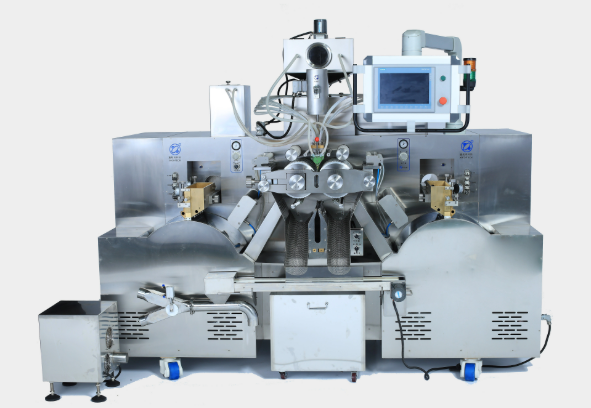
Facility managers must match machine capacities to their actual production demands. Oversizing creates unnecessary operational complexities. Undersizing leads to severe delivery bottlenecks. We break down the three primary equipment categories below.
Laboratories and research facilities rely heavily on pilot-scale systems. The primary target use case involves formulation testing and clinical trial production. Manufacturers also use them for small-batch custom runs.
Success criteria for pilot machines differ from commercial units. You need exceptionally quick changeovers. Minimal material waste remains a priority when testing expensive active pharmaceutical ingredients (APIs). A small footprint allows these machines to fit into cramped laboratory spaces.
Growing nutraceutical brands frequently adopt mid-volume systems. Contract manufacturing organizations (CMOs) also utilize them heavily. These facilities handle multiple client formulations weekly.
Success requires a delicate balance between automation and flexibility. You want enough automation to reduce manual labor. However, you need enough mechanical flexibility to accommodate vastly varied product lines.
Large-scale facilities demand continuous, high-yield architectures. The target use case focuses on 24/7 pharmaceutical manufacturing. These environments tolerate zero unplanned downtime.
Success criteria focus on High Overall Equipment Effectiveness (OEE). You need automated Clean-in-Place (CIP) systems to sanitize tanks without dismantling them. Strict data logging ensures full 21 CFR Part 11 compliance. Validated pharmaceutical machinery handles these rigorous demands effortlessly.
The matrix below highlights the operational differences across the three main production scales.
Scale Category | Primary Use Case | Key Operational Metric | Ideal Facility Type |
|---|---|---|---|
Pilot-Scale | Clinical trials & testing | Changeover speed | R&D Laboratories |
Mid-Volume | Nutraceuticals & CMOs | Format flexibility | Contract Manufacturers |
High-Yield | 24/7 continuous runs | OEE & Automation | Large Pharma Plants |
Selecting the right machinery requires matching specific features to your desired outcomes. You must look past marketing brochures. We will explore the technical dimensions that dictate long-term success. Properly evaluating your softgel capsule manufacturing equipment prevents future operational headaches.
The industry continues to shift away from traditional gear-driven mechanics. Older gear systems suffer from eventual wear and physical backlash. Modern machines utilize independent servo motors for each critical moving part. The medicine pump, die rolls, and casting drums all receive dedicated servo drives.
Outcome: You achieve significantly reduced maintenance downtime. Servo motors allow for tighter seal tolerances on the capsules. This precision directly translates to dramatically lower reject rates during inspection.
Consumer preferences strongly favor plant-based alternatives today. Traditional animal gelatin melts at relatively low temperatures. Plant-based starches and gums behave very differently. Vegan formulations require much higher operating temperatures to flow properly. They also demand specialized die rolls with modified wedge designs.
Outcome: Selecting dual-capable machinery future-proofs your facility. You can quickly adapt to changing consumer excipient preferences without overhauling your entire floor.
Best Practice: Always test your specific vegan excipient blend on a vendor's pilot machine before committing to a commercial-scale unit.
Die rolls represent the critical contact point for capsule formation. You must carefully assess the metallurgical quality of these rolls. Aircraft-grade aluminum often provides the best balance of heat transfer and durability. Furthermore, evaluate the vendor's resharpening and refurbishment programs.
Outcome: High-quality tooling ensures predictable operational continuity. Superior sanitary designs minimize cross-contamination risks between different product batches.
The chart below summarizes the functional differences between drive system technologies.
Feature Dimension | Mechanical Gear Drive | Servo Motor Drive |
|---|---|---|
Timing Adjustments | Manual physical alignment | Digital touchscreen input |
Wear Over Time | Moderate to high backlash | Virtually zero backlash |
Seam Consistency | Acceptable for standard runs | Exceptional for complex shapes |
Buying the machine solves only half the puzzle. Integrating it into your existing facility introduces significant technical hurdles. We outline the most common implementation risks below to help you prepare.
Softgel production routinely fails without strict cleanroom HVAC parameters. Gelatin remains highly sensitive to ambient moisture. The drying rooms require precise environmental constraints. You typically need to maintain temperatures between 20-22°C. Relative humidity must stay strictly between 15-20%.
Common Mistake: Facilities often try to repurpose standard commercial air conditioning units. These standard units cannot remove enough moisture. You must install dedicated desiccant dehumidification systems.
You must address the harsh reality of cleaning validation. Complex medicine pumps contain numerous tiny passages. They can take entire shifts to clean properly. When evaluating equipment, look for tool-less teardown capabilities. Sanitary design features, like tri-clamp fittings and smooth internal welds, accelerate the cleaning process. Faster cleaning means higher machine availability.
Advanced machinery requires highly specialized training. You cannot simply hand an operator a manual and expect perfection. The synchronization of die rolls, wedges, and cooling drums takes practice. Factor in the vendor's on-site commissioning availability. Insist on comprehensive, hands-on training for your entire production crew.
A structured procurement process protects your facility from mismatched equipment. You must formalize your needs before contacting suppliers. Follow these actionable steps to streamline your vendor evaluation.
The URS acts as your foundational engineering document. You must define your exact product matrices clearly. Specify whether you will run oil-based fill liquids or complex suspensions. Suspensions require specialized hopper agitation. Define your target throughput in capsules per hour. Document your exact facility space constraints, including ceiling heights and door widths.
You must look far beyond the polished marketing brochure. Request historical data on machine uptime from the vendor. Ask for reference clients in your specific region. Review their Factory Acceptance Testing (FAT) protocols thoroughly. A rigorous FAT ensures the machine works perfectly before it ever leaves the vendor's facility. Site Acceptance Testing (SAT) confirms it still works after installation.
Machines will eventually require maintenance. Assess the domestic or regional availability of critical spare parts. Heating wedges and distribution plates wear out over time. Reliance on overseas shipping for standard wear parts causes unacceptable delays. Choose vendors who maintain localized inventory hubs.
Selecting softgel manufacturing equipment represents a complex intersection of mechanical engineering, chemistry, and facility design. You cannot treat this process as a simple catalogue purchase. Your success depends entirely on aligning machinery capabilities with your specific formulation requirements.
We strongly recommend prioritizing production flexibility and robust vendor support over baseline capacity metrics. A slightly slower machine with flawless uptime ultimately outperforms a fast machine that constantly breaks down. Focus on integration, cleanability, and precision drive systems.
Take immediate action to secure your production future. Download a comprehensive URS template to begin documenting your needs. Contact a qualified engineering consultant to review your facility constraints. Request a deep technical audit of your current production process today.
A: Servo-driven units use independent digital motors for precise timing of the die rolls and medicine pump. This drastically reduces mechanical wear and backlash. It improves capsule seam quality compared to traditional interconnected mechanical gear systems, which rely on physical shafts and gears.
A: Standard machines often struggle with vegan formulations. While some are dual-purpose, plant-based materials possess higher viscosity and melting points. Running them successfully usually requires upgraded heating controls, modified cooling drums, and specific die roll treatments to prevent sticking.
A: A format changeover typically takes 4 to 8 hours. The exact time depends heavily on your Clean-in-Place (CIP) integration and the chemical differences between the old and new fill materials. Tool-less machine designs can push changeovers closer to the 4-hour mark.
A: The core encapsulator only takes up a few square meters. However, the supporting infrastructure requires significant space. Melting tanks, multi-stage tumble dryers, and dedicated curing rooms require large, specifically climate-controlled square footage to function correctly.


