
- All
- Product Name
- Product Keyword
- Product Model
- Product Summary
- Product Description
- Multi Field Search
 English
Views: 0 Author: Site Editor Publish Time: 2026-09-27 Origin: Site


Transitioning from piecemeal equipment procurement to an integrated setup marks a high-stakes CapEx decision for nutraceutical and pharmaceutical brands. Fragmented facilities often lead to severe integration bottlenecks. You might experience inconsistent yields and compliance vulnerabilities. A unified, end-to-end setup aligns your compounding, encapsulation, and drying phases flawlessly. It drives verifiable return on investment through higher bioavailability standards. You also achieve strict GMP compliance and an accelerated time-to-market. Choosing a comprehensive layout mitigates the inherent risks of disjointed machinery. Companies can focus heavily on product formulation rather than troubleshooting mechanical mismatches. We will explore how abandoning siloed hardware for a synchronized line fundamentally revolutionizes your production capabilities. Unlocking predictable scaling requires moving beyond isolated machines. Let us examine the specific elements ensuring seamless operations and long-term commercial success in competitive pharmaceutical markets.
Integration over isolation: Turnkey systems eliminate vendor interoperability issues, reducing batch loss and downtime.
Quality control automation: Centralized manufacturing systems standardize raw material handling (e.g., gelatin/vegan mass) to ensure consistent dosage and shell stability.
Predictable ROI: While initial CapEx is higher, complete solutions lower long-term OpEx via reduced scrap rates, optimized labor, and faster validation cycles.
Streamlined compliance: Pre-validated end-to-end systems simplify FAT/SAT (Factory/Site Acceptance Testing) and regulatory audits.
Procuring encapsulation equipment from multiple vendors creates an immediate interoperability trap. Mismatched machinery rarely communicates seamlessly. Imagine piping molten gelatin from a melting tank into an encapsulation unit. If thermal controls do not synchronize perfectly, fluid viscosity changes instantly. This minor temperature fluctuation causes massive material waste. Hidden costs emerge quickly when engineers must build custom interfaces. You lose valuable production time retrofitting components.
Vendor finger-pointing becomes inevitable during multi-vendor setups. Yield drops and mechanical failures require swift troubleshooting. However, disparate systems blur accountability. The melting tank manufacturer might blame the transfer pump provider. The encapsulation vendor might blame the gelatin consistency. You remain stuck navigating endless technical disputes. Resolution timelines stretch from hours to weeks. Plant managers need unified accountability to maintain optimal uptime.
Validation delays represent another major financial drain. Pharmaceutical manufacturing requires rigorous Installation Qualification (IQ) and Operational Qualification (OQ). Validating separate pieces of equipment compounds your compliance timeline. Each standalone machine requires distinct documentation. A fully integrated capsule production line shares one master validation protocol. You execute continuous testing across the entire system simultaneously. This unified approach cuts pre-commercialization delays drastically. You launch products faster and capture market share sooner.
Mismatched transfer pump capacities causing gelatin flow starvation.
Incompatible PLC (Programmable Logic Controller) communication protocols.
Varying hygienic design standards complicating clean-in-place routines.
Inconsistent thermal jacketing leading to premature gelatin curing.
End-to-end process synchronization defines the highest tier of manufacturing excellence. Medicine preparation flows logically into the gelatin melting phase. These materials then transfer directly into the encapsulation tooling. Every temperature zone remains strictly monitored. Pumping speeds adjust dynamically based on real-time hopper levels. You eliminate manual material handling entirely. This creates a closed-loop environment safeguarding product integrity.
Formulation versatility ensures your facility remains future-proof. Modern consumer demands require complex fill materials. You must handle thick suspensions and high-viscosity pastes. Small molecule APIs require extreme dosing precision. A comprehensive turnkey softgel solution accommodates these rigorous demands effortlessly. Precision dosing pumps maintain strict tolerances. You achieve consistent bioavailability regardless of the core formulation.
Yield optimization directly impacts your operational profitability. Advanced units feature real-time ribbon thickness monitoring. Automated adjustments prevent costly shell leakers. Thinner ribbons reduce gelatin waste significantly. Operators no longer rely on manual micrometer checks. The system autocorrects minute deviations before they cause batch failures. You maximize your active pharmaceutical ingredient (API) utilization rates.
Adaptability for novel materials provides a massive competitive advantage. Traditional bovine and porcine gelatins dominate the market. However, consumer preferences shift heavily toward plant-based alternatives. Emerging polymers like tapioca and carrageenan operate under vastly different thermal profiles. They require higher melting temperatures and distinct cooling parameters. Top-tier systems engineer this flexibility inherently. You switch between animal and vegan runs without overhauling your entire production floor.
Raw Material Compounding: Precision heating and mixing of API and shell ingredients.
Vacuum Transfer: Bubble-free material movement into heated machine hoppers.
Automated Encapsulation: Synchronized wedge heating and die roll stamping.
Inline Tumble Drying: Immediate moisture reduction preventing capsule deformation.
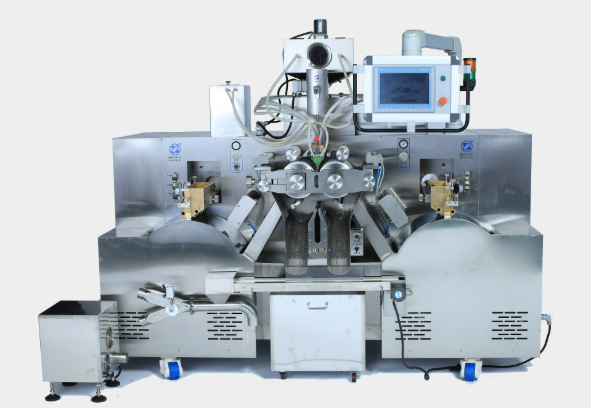
Meeting strict GMP compliance demands automated quality control. Built-in sensors constantly monitor ambient temperature and relative humidity. Fill-weight accuracy mechanisms remove human error from critical control points. Manual sampling introduces unacceptable contamination risks. Automated check-weighers reject out-of-spec capsules instantly. You guarantee every single dose meets regulatory guidelines. This protects your brand reputation fiercely.
Audit-ready data trails simplify regulatory inspections. Centralized HMI and PLC systems provide comprehensive data logging. These setups meet strict CFR 21 Part 11 requirements for electronic records. Auditors require verifiable batch traceability. Unified software records every parameter shift, operator login, and alarm state. You generate compliance reports with a single keystroke. A robust pharmaceutical solution makes audit preparation virtually effortless.
Cross-contamination mitigation remains critical for multi-product facilities. Hygienic design features must exist systematically. Top-tier unified setups incorporate inherent CIP (Clean-in-Place) and SIP (Sterilize-in-Place) capabilities. Engineers design piping networks without dead legs. Stainless steel finishes meet exact surface roughness standards. Washdown procedures happen swiftly and effectively. You ensure zero active ingredient carryover between distinct production batches.
Utilize dedicated change parts for highly potent APIs.
Schedule regular swab testing on gelatin transfer hoses.
Implement strict differential pressure zones around the encapsulation machine.
Automate CIP cycles to ensure repeatable cleaning efficacy.
Balancing CapEx against OpEx requires a strategic financial perspective. The upfront investment for an integrated line is undeniably higher. However, operational savings offset this premium rapidly. Energy consumption drops when heating systems communicate efficiently. Material scrap rates plummet due to synchronized controls. Labor hours decrease as automated transfers replace manual bucket lifting. You achieve a faster break-even point through relentless efficiency.
Speed to market accelerates dramatically. Unified systems reduce the timeline from formulation R&D to commercial-scale output. Pre-engineered interfaces bypass months of custom integration work. You scale formulations predictably. Lab-scale parameters transfer to commercial die rolls seamlessly. A synchronized manufacturing system ensures you capitalize on emerging health trends immediately. Delays in commercialization cost millions in lost revenue.
Scalability metrics dictate your long-term growth trajectory. Evaluating upgrade paths is critical before purchase. Consider the ease of swapping die rolls for higher throughput. Can the current tumble dryers handle increased output? Complete solutions modularize these expansion points. You add secondary drying tunnels without disrupting the primary encapsulation phase. Your facility scales smoothly alongside rising market demands.
Cost & Performance Category | Fragmented Setup | Complete Unified System |
|---|---|---|
Initial Capital Expenditure | Moderate | High |
Integration & Engineering Costs | High (Extensive custom work) | Minimal (Pre-engineered) |
Average Material Scrap Rate | 5% - 15% | Under 2% |
Validation & Compliance Timeline | 8 - 12 Weeks | 2 - 4 Weeks |
Labor Requirements | High (Manual transfers) | Low (Automated flow) |
The Factory Acceptance Testing (FAT) process determines your rollout success. Demand rigorous testing before the equipment leaves the vendor facility. Run placebo batches mimicking your toughest formulation. Verify PLC communication under simulated alarm conditions. Site Acceptance Testing (SAT) follows installation. This confirms the machinery survived shipping and integrates into your plant infrastructure. Skipping FAT/SAT protocols invites catastrophic operational failures.
Facility readiness requires transparent baseline assumptions. A complete machine still demands an optimized surrounding environment. Softgel production is highly sensitive to ambient moisture. Your HVAC systems must deliver immense dehumidification power. Drying rooms typically require relative humidity levels between 20% and 30%. Inadequate climate control ruins perfectly encapsulated batches. Upgrading cleanroom air handling units is non-negotiable.
Operator adoption determines your ultimate daily yield. Continuous softgel production features a notoriously steep learning curve. Operators must understand gelatin viscosity dynamics and wedge temperature interplay. Vendor-supplied Standard Operating Procedures (SOPs) are critical. Demand comprehensive hands-on training from the manufacturer's engineers. Shadowing experts during the SAT phase builds internal team confidence. Untrained operators will degrade the performance of world-class equipment.
Dedicated chilled water loops for die roll cooling.
High-capacity desiccant dehumidifiers for tumble drying rooms.
Three-phase power supplies with uninterruptible power backups.
Epoxy flooring with appropriate drainage for CIP washdowns.
Moving beyond basic spec sheets is essential. Evaluate the engineering support infrastructure of your potential partner. Spare parts availability dictates your disaster recovery timeline. A broken transfer pump can halt your entire facility. Assess domestic versus international service Level Agreements (SLAs). Can they deploy a technician within 24 hours? Remote diagnostic capabilities via secure VPNs offer tremendous value during sudden downtime.
Mandating a proof of concept prevents costly missteps. Request pilot runs using your specific API or nutraceutical fill. Verify dosing accuracy through independent laboratory testing before final sign-off. High-viscosity pastes often expose weaknesses in substandard injection wedges. A credible partner welcomes these challenging pilot runs. They use the data to optimize die roll geometries for your exact product.
Drafting a Request for Proposal (RFP) requires precision. Focus on outcome-based guarantees rather than just mechanical outputs. Do not simply ask for "a machine that produces 100,000 capsules per hour." Ask for guarantees on maximum scrap rates. Request definitive timelines for CIP cycle completion. Demand specified tolerances for ribbon thickness variations. Outcome-based RFPs force vendors to stand behind their holistic system design.
A complete softgel manufacturing solution represents a fundamental risk-mitigation strategy for commercial scaling. Relying on disconnected hardware compromises product integrity and slows commercialization. Unified systems eliminate unpredictable variables. They standardize thermal controls, synchronize fluid transfers, and automate critical quality checkpoints. You safeguard expensive active ingredients while strictly adhering to pharmaceutical regulations.
Investing in an integrated system provides the ultimate operational baseline. You gain the capabilities required to compete fiercely on product quality and profit margin. The reduction in daily scrap rates and manual labor hours transforms your profitability curve. Plant managers regain control over production schedules. Quality assurance teams easily generate flawless audit trails.
Do not let fragmented equipment stifle your market potential. Consult with an experienced systems engineer today. Request a comprehensive ROI analysis tailored strictly to your specific formulation needs. Embrace the reliability of synchronized production and elevate your manufacturing standards.
A: It is an integrated production system that includes all necessary equipment—gelatin melting tanks, mixing vessels, the main encapsulation machine, tumble dryers, and inspection tooling—designed to work seamlessly together under a unified control system.
A: Turnkey systems offer centralized data logging, standardized hygienic designs (CIP), and unified validation protocols (IQ/OQ/PQ), making it significantly easier to prove batch consistency and traceability to regulatory auditors.
A: Depending on the manufacturer and customization requirements, implementation typically takes 4 to 8 months, encompassing equipment fabrication, FAT, shipping, facility integration, SAT, and final operator training.
A: High-end modern systems can handle both, but they require specific adaptations. Vegan (plant-based) gels typically operate at higher temperatures and viscosities, requiring upgraded heated hoses, specialized transfer pumps, and tailored die roll designs.


