
- All
- Product Name
- Product Keyword
- Product Model
- Product Summary
- Product Description
- Multi Field Search
 English
Views: 143 Author: Site Editor Publish Time: 2026-09-09 Origin: Site


Rising consumer demand for high-bioavailability formats has transformed the modern health market. Easy-to-swallow delivery methods have shifted softgels from a niche pharmaceutical format to a nutraceutical baseline. Consumers now expect premium supplements to offer superior absorption and comfort. Businesses face a major hurdle when moving away from outsourced contract manufacturing. Transitioning to in-house production requires significant upfront capital expenditure. You must carefully align machine capabilities with specific formulation requirements. Misaligning these elements often leads to high scrap rates and frequent downtime. Poor equipment choices also compromise batch uniformity across your production runs.
The purpose of this article is to clarify the primary applications of these machines in our industry. We will provide an evidence-based framework for evaluating and implementing this specialized machinery. You will learn how to shortlist vendors based on actual production capabilities. By the end, you will understand how to optimize your manufacturing lines for long-term operational success.
Core Applications: Modern equipment supports lipophilic liquids, complex botanical suspensions, and temperature-sensitive active ingredients, directly impacting portfolio expansion.
Evaluation Criteria: Procurement should prioritize injection wedge precision, cooling drum temperature stability, and clean-in-place (CIP) efficiency over baseline output speeds.
Implementation Reality: Successful deployment requires factoring in auxiliary environmental controls (HVAC/dehumidification) and gelatin preparation infrastructure, not just the encapsulation unit.
Vendor Selection: Shortlisting must rely on verifiable Factory Acceptance Testing (FAT), cGMP documentation, and local technical support availability.
Lipophilic nutrients represent the foundation of oil-based encapsulation. Facilities commonly process Omega-3 fish oils, Vitamin D3, Vitamin E, and CoQ10 in this category. These nutrients require optimal delivery vehicles to maintain their bioavailability profiles. Your operational focus must center heavily on oxidation prevention. Equipment operators must maintain strict anaerobic conditions throughout the encapsulation process. Nitrogen blanketing systems often help facilities achieve this goal reliably. If oxygen interacts during processing, active ingredients degrade rapidly. We often see manufacturers lose entire batches due to poor atmospheric control. This makes specialized softgel machine applications critical for protecting high-value oil portfolios.
Best Practice: Always purge the material hoppers using food-grade nitrogen before introducing sensitive fish oils. This simple step drastically reduces peroxide values in the finished product.
Complex suspensions and pastes present a different operational challenge. Formulators increasingly utilize botanical extracts and multi-vitamin matrices. These heavy particulate formulas demand careful handling mechanisms. Standard processing equipment struggles to handle them efficiently. Your operational focus shifts entirely to material flow and consistency. This scenario requires specialized mixing hoppers to keep heavy particles fully suspended. You also need customized injection wedges to prevent equipment clogging. A clogged wedge disrupts dose uniformity instantly and ruins the batch.
Common Mistake: Operators often attempt to run thick botanical pastes through standard oil wedges. They experience immediate pressure buildup, causing inconsistent fill weights and leaking capsule seams.
Plant-based formulas require highly specific thermodynamic settings. Many modern brands now request tapioca or carrageenan-based vegan shells. Consumers also increasingly demand chewable format products. Your operational parameters must adapt to these new raw materials. Vegan films behave very differently compared to traditional bovine or porcine gelatin. They generally require significantly higher sealing temperatures to form properly. Operators must also maintain precise ribbon thickness control at all times. Minor temperature fluctuations easily cause weak seams in vegan capsules. Exploring advanced soft capsule applications helps technicians master these specific thermal requirements effectively.
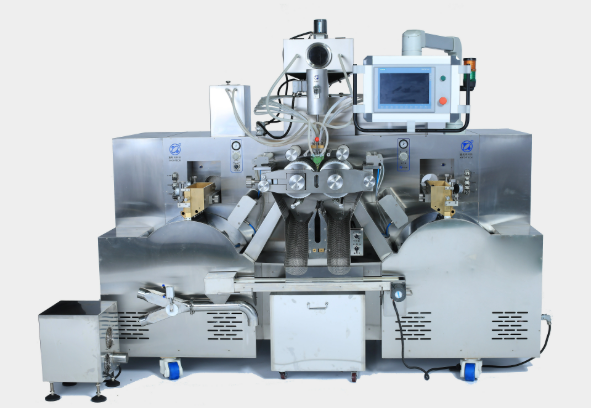
Selecting the right nutraceutical manufacturing equipment dictates your future production efficiency. Procurement teams must look past theoretical maximum speeds. You must evaluate how specific machine features translate into tangible production outcomes.
Feature: Micro-adjustable positive displacement pump systems.
Mechanism: These pumps control the exact volume of liquid entering the capsule cavity. They allow operators to make microscopic volume adjustments during active production.
Outcome: This precision minimizes fill-weight variance across thousands of capsules. Strict weight control ensures complete regulatory label claim compliance. It also significantly reduces expensive active pharmaceutical ingredient (API) waste.
Feature: Aviation-grade aluminum die rolls featuring automated alignment protocols.
Mechanism: The die rolls cut and seal the gelatin ribbons simultaneously. Automated alignment prevents the rolls from shifting out of phase.
Outcome: Perfectly aligned rolls produce significantly stronger seal seams. Stronger seams minimize leaky capsules during the drying phase. This optimization maximizes overall gelatin yield and reduces net material scrap.
Feature: Integrated tumble dryers featuring advanced moisture extraction blowers.
Mechanism: Freshly formed capsules contain excess moisture. These dryers rapidly remove surface water before the capsules move to curing trays.
Outcome: Efficient initial drying reduces severe bottlenecking post-encapsulation. It ensures the structural integrity of the capsule remains intact. Strong capsules survive the subsequent polishing and packaging stages effortlessly.
Buying high-quality health product machinery solves only part of the manufacturing equation. Facility infrastructure plays an equally crucial role in your success.
Softgel encapsulation remains highly sensitive to ambient humidity and temperature. The gelatin ribbons will melt or turn brittle under incorrect atmospheric conditions. Facilities must invest heavily in specialized HVAC systems. You also need commercial-grade desiccant dehumidification units. A standard production suite typically requires less than 20% relative humidity at 20°C. Attempting to run a machine in an uncontrolled room guarantees failure.
The encapsulation machine is only as good as the gelatin mass fed into it. Gelatin preparation requires exact scientific timing and temperature control. Melting tanks, holding tanks, and thermal transfer piping must undergo perfect calibration. Poorly calibrated tanks lead to severe viscosity fluctuations. If the gelatin mass becomes too thick, the ribbons will not form evenly. If it becomes too thin, the capsules will burst during sealing.
Agile manufacturing requires frequent product changeovers. You must perform rigorous cleaning validation for oil-to-paste runs. Allergen-containing runs demand even stricter sanitation protocols. Procurement teams often miscalculate turnaround times. You should evaluate the actual tear-down time of the tooling carefully. Never rely solely on the manufacturer’s advertised turnaround time. Complex pump systems often take hours to sanitize properly.
Table: Troubleshooting Common Implementation Risks
Operational Risk | Primary Cause | Recommended Solution |
|---|---|---|
Leaking Seams | Die roll misalignment or low sealing temperature. | Recalibrate timing marks; increase wedge heat by 1-2°C. |
Capsule Dimpling | Excessive moisture or rapid cooling post-extrusion. | Adjust tumble dryer airflow; check ambient room humidity. |
Inconsistent Weights | Air trapped in the positive displacement pump. | Bleed the pump lines; verify hopper nitrogen pressure. |
Ribbon Tearing | Gelatin mass viscosity is too high or chilled too fast. | Check holding tank temperatures; adjust cooling drum coolant flow. |
Scaling your supplement production requires logical vendor evaluation. You must align your equipment choices strictly with your realistic business objectives.
Match your machine output capabilities to your realistic sales forecasts. Benchtop machines typically utilize 2-inch to 4-inch die rolls. Commercial scale systems often deploy 10-inch die rolls. Over-indexing on capacity increases upfront capital expenditure unnecessarily. Large machines also generate excessive operational waste during small-batch trial runs. You should purchase equipment matching your next three years of projected volume.
Chart: Equipment Capacity vs. Scale Comparison
Scale Category | Die Roll Size | Typical Output (Capsules/Hour) | Best Use Case |
|---|---|---|---|
R&D / Benchtop | 2" - 4" | 10,000 - 25,000 | Formulation testing, clinical trial batches. |
Pilot / Mid-Scale | 6" - 8" | 40,000 - 80,000 | Regional product launches, moderate volume SKUs. |
Commercial | 10" + | 100,000+ | High-volume continuous manufacturing, global distribution. |
Regulatory compliance protects your business from audit failures. Ensure your chosen vendor provides comprehensive validation protocols. You will need Installation Qualification (IQ), Operational Qualification (OQ), and Performance Qualification (PQ) documents. FDA inspectors and cGMP auditors require these protocols during routine facility checks. Equipment lacking proper validation documentation becomes a massive liability. Ask vendors for sample documentation packages before signing purchase agreements.
Do not base your decision solely on the sticker price. You must factor in the long-term operational expenses extending over a 5 to 10-year lifecycle. Calculate the average cost of OEM replacement parts carefully. Evaluate the availability of localized technician support in your region. Assess the physical durability of the die roll tooling. Finally, estimate the daily energy consumption of the dryers and melting tanks. A cheaper machine often costs significantly more in downtime and emergency repairs.
Vendor Shortlisting Best Practices:
Demand a verifiable Factory Acceptance Test (FAT) using your specific formulation.
Request detailed mean-time-between-failure (MTBF) data for the injection pumps.
Verify the vendor maintains an active spare parts inventory in your country.
Check references from facilities currently running similar botanical or vegan formulas.
Investing in softgel technology is not merely a standard equipment purchase. It represents the integration of a highly sensitive thermodynamic process into your facility. Your success depends entirely on controlling the environment, the materials, and the machinery simultaneously. Choosing the wrong parameters leads to expensive material waste and delayed product launches.
We strongly recommend basing your procurement decision on specific formulation applications. You must evaluate the vendor’s proven ability to support active formulation trials. They should also execute comprehensive IQ/OQ validation smoothly. Avoid vendors who refuse to test your exact complex suspensions or plant-based materials before purchase.
Your immediate next step is to draft a comprehensive User Requirement Specification (URS). Detail your specific fill materials, expected throughput, and physical facility constraints. Send this URS to multiple manufacturers before requesting any formal proposals or price quotes.
A: Not always without modification. Vegan gels require distinct melting temperatures, different holding tank specifications, and customized heating wedges. Always verify multi-material compatibility with the OEM.
A: While manufacturers often claim 98%+ yields, realistic initial scrap rates during process qualification range from 5-10%, stabilizing to 2-4% once operators are trained and environmental controls are dialed in.
A: Post-encapsulation, softgels must cure in drying tunnels or trays before they can be bottled or blister-packed. Equipment must be sequenced carefully to prevent downstream bottlenecks.


