
- All
- Product Name
- Product Keyword
- Product Model
- Product Summary
- Product Description
- Multi Field Search
 English
Views: 129 Author: Site Editor Publish Time: 2026-08-12 Origin: Site


Establishing or scaling a softgel line is a capital-intensive process. It demands precise synchronization between material preparation, encapsulation, and environmental controls. Manufacturers face immense pressure to master these variables immediately. A functional setup extends far beyond the main encapsulation unit. You must build a tightly integrated system to ensure batch-to-batch consistency. High yields and strict cGMP regulatory compliance depend on this integration. Ignoring your auxiliary capacities frequently causes severe processing bottlenecks. It also leads to costly product waste. This guide provides a detailed technical breakdown of the required machinery. We evaluate core procurement criteria alongside specific facility prerequisites necessary for successful implementation. You will discover exactly how to balance your processing units. This knowledge helps you maximize overall operational efficiency.
A complete softgel line requires four primary equipment modules: Gelatin/Fill Preparation, Encapsulation, Drying, and Inspection/Finishing.
The rotary die encapsulation machine is the core asset, but auxiliary systems (melting tanks, tumble dryers) dictate overall production bottlenecks.
Environmental control (HVAC) is as critical as the machinery; softgel drying requires strict temperature and relative humidity (RH) parameters.
Procurement evaluation must prioritize tooling changeover times, dose accuracy, and cGMP integration over raw theoretical output speeds.
Buying a standalone encapsulation machine often leads to massive processing bottlenecks. You cannot operate it efficiently without matching auxiliary capacities. Mismatched equipment directly causes severe product loss. Buyers must view the production floor as a continuous ecosystem. Each stage depends heavily on the output of the previous step. If your drying capacity cannot handle your encapsulator's speed, operations inevitably halt. You need a fully synchronized capsule manufacturing system to succeed.
A functional production ecosystem operates in four distinct phases. Breaking the process into specific modules helps managers identify potential fail points early.
Module 1: Preparation. These systems melt the gelatin and mix the active fill material. The fill can be a liquid, suspension, or paste.
Module 2: Encapsulation. This is the primary mechanism. The gel ribbon and fill material converge here to form the actual capsule.
Module 3: Drying. This entails a multi-stage moisture removal process. It utilizes both dynamic tumbling and static tray resting.
Module 4: Finishing & Inspection. These final systems clean, sort, and verify quality. They ensure capsules meet standards before bulk packaging.
Failing to invest adequately in Module 1 or Module 3 will cripple Module 2. Operators must align throughput rates across all four modules.
The preparation phase determines the final quality of your capsule shell and its contents. You must prepare both elements meticulously before they reach the encapsulation machine. Inconsistent gelatin viscosity or poorly mixed active ingredients will ruin an entire batch.
These units serve a highly specialized function. They are jacketed, vacuum-capable stainless steel tanks. Operators use them to mix gelatin powder, purified water, and plasticizers like glycerin. The jacketed design allows hot water to circulate and melt the mixture evenly.
When evaluating these tanks, several key specifications demand your attention. Heating uniformity is non-negotiable. Cold spots create lumps in the gel mass. You also need robust vacuum pressure capacity. Vacuum systems perform crucial deaeration. They remove microscopic air bubbles from the mixture. Bubbles cause weak spots and leaks in the final capsule shell. Finally, analyze the agitator design. It must scrape the tank walls cleanly to prevent material buildup.
You need specialized processing equipment to prepare active pharmaceutical ingredients (API) or nutraceuticals. The specific machinery depends entirely on your formulation.
Inline Homogenizers: They blend oil-based liquids seamlessly.
High-Shear Mixers: These machines handle thicker, more complex formulations efficiently.
Colloidal Mills: They are absolutely essential for suspension fills. They grind solid particles down to microscopic sizes. Large particles will block the delicate injection needles during encapsulation.
Investing in high-quality mixing systems prevents costly downtime. Properly milled suspensions flow smoothly through your nutraceutical machinery.
Moving the prepared gel mass presents another logistical challenge. You must maintain optimal viscosity during transfer. Heated transfer pipes prevent the gelatin from hardening prematurely. Mobile holding tanks provide a vital buffer zone. They store the ready-to-use gel mass at exact temperatures. These tanks sit beside the main encapsulator, ensuring a steady, uninterrupted supply.
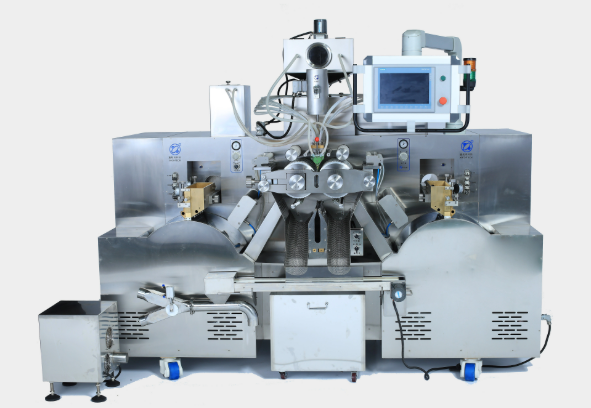
The rotary die process serves as the central hub of your entire operation. This machine physically brings the shell and the active ingredients together. It converts the warm gelatin mass into two flat ribbons. The machine feeds these ribbons through counter-rotating die rolls. Simultaneously, a positive displacement pump injects the active fill material directly between the ribbons. The pressure from the die rolls cuts and seals the capsule instantly.
You must evaluate specific mechanical components when selecting softgel production equipment. Do not simply look at theoretical output speeds.
Medicine Pump: This unit drives your dose accuracy. It must feature micro-adjustment capabilities. Precise pumps prevent expensive API giveaway. They also prevent dangerous under-dosing.
Tooling (Die Rolls & Wedge): This tooling determines the capsule shape and size. It also guarantees seal integrity. Poorly machined die rolls cause leakers and misshapen products.
Spreader Boxes & Cooling Drums: The spreader box dictates ribbon thickness. The cooling drum initiates the initial curing process. If the drum temperature fluctuates, the ribbon becomes either too brittle or too sticky.
Modern manufacturing requires robust automation. Operators cannot rely on manual dial adjustments alone. High-end systems feature PLC-based touchscreens. They allow seamless recipe management. Operators can save specific parameters for different products. Automated ribbon thickness adjustments reduce human error significantly. Furthermore, your pharmaceutical equipment must include secure audit trails. Compliance with 21 CFR Part 11 is mandatory for regulated medical production. This software logs every single adjustment made by any operator.
Drying represents the longest phase of softgel manufacturing. It is almost always the most common facility bottleneck. Facility planners frequently underestimate the spatial requirements for this stage. Proper curing requires extensive time, space, and strictly controlled atmospheric conditions.
We divide the moisture removal process into two distinct stages.
Softgel Drying Phases Comparison
Phase | Equipment Used | Moisture Removed | Duration | Primary Function |
|---|---|---|---|---|
Primary Drying | Tumble Dryers | 20% - 30% | 30 - 60 Minutes | Sets the initial capsule shape and prevents sticking. |
Secondary Drying | Drying Tunnels (Trays) | Remaining target moisture | 24 - 72 Hours | Slow, static curing to achieve final shell hardness. |
Capsules fall immediately into tumble dryers after exiting the die rolls. These rotating baskets catch the soft, fragile capsules. The tumbling action removes surface moisture quickly. It eliminates about 20% to 30% of the total water content. This phase gives the capsule its permanent shape. When evaluating tumble dryers, look for variable speed drives. You also want anti-stick coatings inside the baskets. Integrated blowers help move dry air across the capsules efficiently.
After tumbling, workers transfer the capsules onto specialized shallow trays. They stack these trays on mobile trolleys. The trolleys enter dedicated drying tunnels. This constitutes static drying. Capsules rest here for 24 to 72 hours, depending on the formulation.
This phase requires a rigid facility requirement check. You need highly controlled cleanrooms for secondary drying. The HVAC system must maintain temperatures precisely between 20–24°C. Relative Humidity (RH) must stay locked at approximately 20%. Any deviation in RH will ruin the batch. If humidity spikes, the capsules melt together. If it drops too low, they crack.
Capsules are not ready for packaging when they leave the drying tunnel. They require several finishing steps to ensure safety and aesthetic appeal. The encapsulation process uses food-grade mineral oil to lubricate the gel ribbons. This oil remains on the dried capsules. It makes them look cloudy and feel greasy.
Polishing machines remove this residual mineral oil efficiently. Some machines use absorbent cloths inside a rotating drum. Others use harmless solvents to wash the exterior. Clean capsules look shiny and slide easily into blister packs or bottles. Skipping this step leads to rejected lots and unhappy consumers.
Quality control is a mandatory step. You must remove any defective units.
Manual Inspection: Workers spread capsules across illuminated light-boxes. They manually pick out bubbles, leakers, or twin capsules. This method is slow and prone to eye fatigue.
Automated Optical Sorting: Many facilities are transitioning to automated systems. High-speed cameras scan each individual capsule. The software detects microscopic malformations. It ejects defective units instantly using targeted bursts of compressed air.
Finally, the batch passes through mechanical sorters. Sizers reject capsules that fall outside acceptable dimensional tolerances. If a capsule is too fat or too thin, it will jam automatic bottling lines later. Sizers guarantee uniform physical dimensions across your entire production run.
Procuring soft capsule manufacturing equipment involves rigorous vetting. You cannot simply order a machine out of a catalog. You must evaluate how the machinery fits your specific operational reality.
You must match machine output with your available cleanroom square footage. High-speed machines produce tens of thousands of capsules per hour. However, they require exponentially larger drying footprints. If you buy a massive encapsulator but lack tray space, the machine will sit idle. Calculate your total spatial limits before looking at output numbers.
Contract manufacturers switch products frequently. Changeover efficiency dictates your profitability. Evaluate the time required to swap die rolls. Calculate how long it takes to clean the medicine pump. Look specifically for "tool-less" component designs. Systems that assemble without wrenches save hours of labor every week.
The industry is moving rapidly beyond traditional animal gelatin. Many brands demand vegetarian alternatives. Materials like tapioca or seaweed-based carrageenan operate at very different viscosities. They require much higher melting temperatures. Your equipment must handle these plant-based gels. Look for specialized spreader boxes and modified heating systems to accommodate vegan formulations.
Prioritize vendors who offer comprehensive support structures. Request robust IQ/OQ (Installation and Operational Qualification) documentation. This paperwork proves the machine operates as advertised. Ensure the vendor guarantees local spare parts availability. Finally, insist on a thorough Factory Acceptance Testing (FAT) protocol. You should test the machine with your actual raw materials before it leaves the vendor's facility.
Successfully launching a softgel line demands a holistic procurement mindset. You must balance the capabilities of your primary encapsulation machine with your auxiliary infrastructure. The capacities of your melting tanks and drying tunnels must align perfectly with your encapsulator's output.
Audit your facility comprehensively before requesting quotes. Check your HVAC capabilities carefully. Measure your spatial constraints to ensure trolleys can move freely. Once you understand your physical limits, document your needs.
Your immediate next step is developing a comprehensive User Requirement Specification (URS). Detail your specific fill materials inside this document. State your exact target yield and specific compliance needs. Present this URS to equipment manufacturers. This detailed approach guarantees highly accurate and actionable RFP responses.
A: A standard production line generally requires between 1,000 and 2,500 square feet. The actual encapsulation machine has a relatively small footprint. However, the secondary drying tunnels demand immense space. Drying infrastructure typically requires two to three times more square footage than the primary processing machinery.
A: Yes, but it requires specific hardware modifications. Vegan materials operate at higher temperatures and thicker viscosities. You will need upgraded heating elements in the transfer pipes. You also need specialized spreader boxes designed specifically to extrude dense, plant-based gels smoothly.
A: B2B timelines typically range from 3 to 6 months. Lead times depend heavily on the level of customization required. Adding advanced automation or specialized vegan modifications extends manufacturing time. Thorough Factory Acceptance Testing (FAT) also adds several weeks to the final delivery schedule.
A: Softgel lines require robust industrial utilities. You need reliable 3-phase electrical power. You must install a commercial chilled water system to regulate the cooling drums. The machinery also requires clean, oil-free compressed air. Finally, you need a specialized HVAC unit capable of maintaining strict low-humidity environments.


